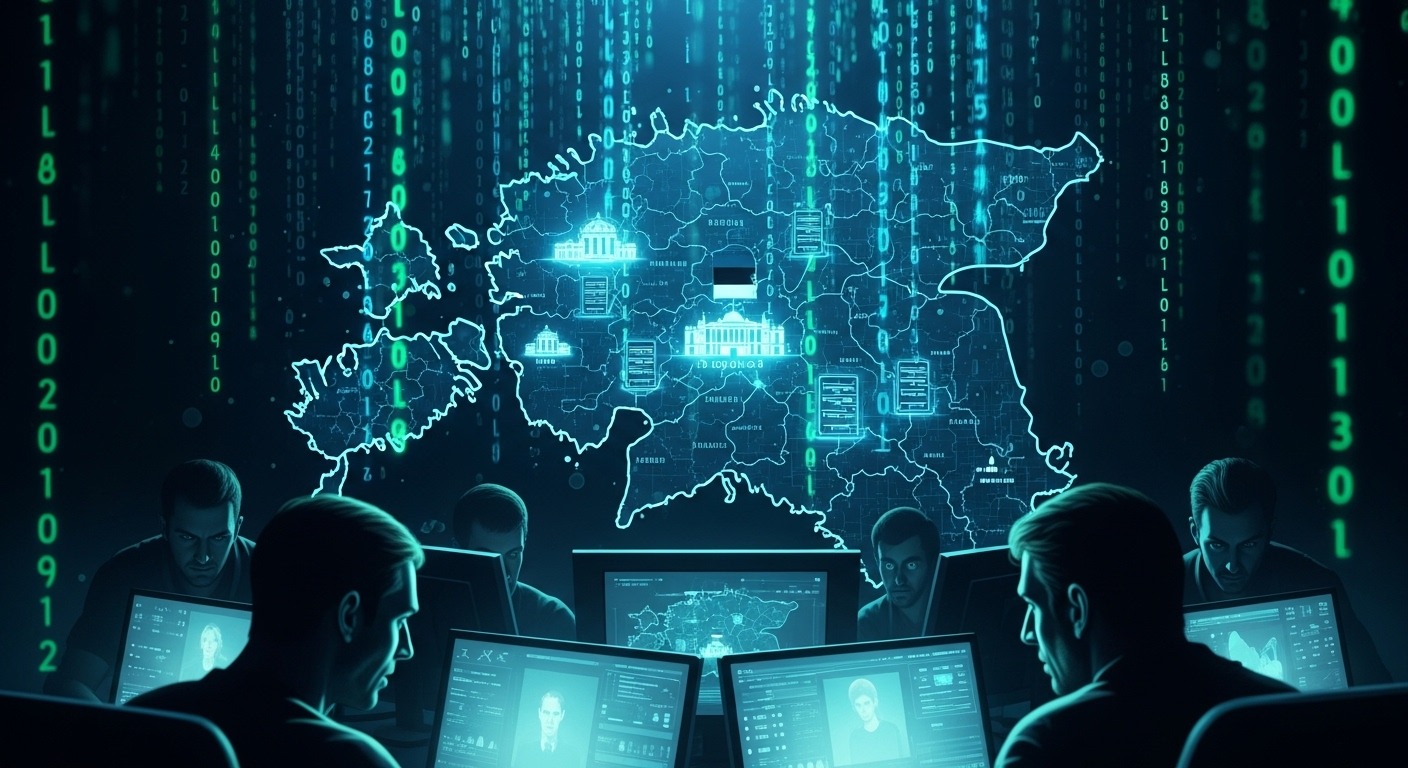
Vadim’s hands were shaking. He wasn’t a hacker, a programmer, or even particularly skilled with computers. Like millions of others, he mostly used his PC for video games. Yet in that moment, sitting in front of his screen, Vadim was about to take part in something unprecedented — the first full-scale cyberwar in history.
All he did was copy a line of code from a gaming forum, paste it into the command prompt, and press enter. That single action sent thousands of requests to a server hundreds of miles away. Then thousands more people did the same. Within seconds, the server was overwhelmed. A website went down. Then another. And another.
By the end of the day, an entire country was under attack.
The Birth of Cyberwarfare
The year was 2007, and the target was Estonia — a small Northern European nation roughly the size of Ohio, with a fraction of its population. Estonia was not a military superpower. But it was something else entirely: one of the most digitally advanced societies on Earth.
Banking, taxes, government services, and even voting had been rapidly digitized. What made Estonia efficient also made it vulnerable. And someone noticed.
The attack that unfolded would permanently alter how wars are fought. For the first time in history, civilians using home computers became soldiers, and the battlefield existed entirely online.
A Country Built on Digital Foundations
To understand why Estonia was targeted, one must understand its history. For centuries, Estonia was fought over by empires — Denmark, Sweden, Germany, Poland, and Russia — with little regard for the local population.
After briefly gaining independence following the collapse of the Russian Empire, Estonia was occupied by the Soviet Union during World War II. When the USSR finally dissolved in the early 1990s, Estonia emerged determined never to fall behind again.
The solution was radical modernization. Estonia embraced the internet early, digitizing state services faster than almost any other country. By the mid-2000s, this digital transformation had become a point of national pride.
But not everyone saw Estonia’s independence as a success.
The Trigger: A Statue and a Symbol
At the center of the crisis stood a bronze statue of a Soviet soldier in Tallinn. For ethnic Estonians, it symbolized decades of occupation. For many ethnic Russians, it represented victory over fascism.
The Estonian government decided to move the statue and associated war graves to a military cemetery. The plan was shared with Russia. No response came.
When the relocation began in April 2007, tensions exploded.
From Political Provocation to Digital Attack
Enter Konstantin Goloskokov — a young Russian political operative and member of Nashi, a Kremlin-backed youth movement designed to mobilize nationalist sentiment while appearing grassroots.
Goloskokov seized the moment. The narrative was simple: Estonia was becoming fascist, disrespecting Soviet sacrifices, and threatening Russian minorities. Russian media amplified the message relentlessly.
Then came the call to action.
Forum posts appeared across the Russian internet encouraging ordinary users to “fight fascism” by running simple commands. No hacking skills required. Just copy, paste, and press enter.
Vadim was one of thousands who answered.
Execution: The Perfect Hybrid Attack
The attack unfolded in multiple layers — what is now known as hybrid warfare.
First came information warfare: propaganda, misinformation, and emotional manipulation. Then civil unrest, as riots erupted in Estonia’s streets.
Finally, the cyberattack escalated.
Phase One: DDoS Floods
Basic ping floods overwhelmed government and media websites. Individually weak, collectively devastating.
Phase Two: Botnets
More sophisticated attacks followed. Malware-infected devices around the world formed botnets, sending realistic traffic that bypassed basic defenses. Banking systems were targeted next.
Phase Three: Intrusions
Skilled hackers attempted phishing, code injection, and system breaches. Some succeeded.
Government services, news outlets, and banks went offline. Estonia’s largest bank, Swedbank, was crippled. Emergency services were targeted next — including the 112 emergency number.
Had that attack succeeded, lives could have been lost.
A Nation Under Siege
For days, Estonia was paralyzed. Financial transactions stopped. News access was limited. Public trust wavered.
Yet Estonia adapted quickly. Server capacity was increased. Traffic filtering improved. Emergency systems were protected. The attacks were contained.
The riots subsided. The country survived.
But the world had changed.
Post-Mortem: The Truth Comes Out
For years, Russia denied involvement. But in 2009, a Russian parliamentarian admitted the attack was organized by his aide. Later that year, Goloskokov publicly claimed responsibility — while insisting it was a “patriotic grassroots movement.”
Few believed that.
The Estonian government took a radical step: transparency. Nearly everything was declassified. Estonia openly accused Russia — something unheard of at the time.
This openness transformed the attack into a global case study.
Lessons That Shaped the Future
The 2007 Estonia cyberattack reshaped global security thinking:
-
DDoS attacks became mainstream weapons
-
Botnets evolved into daily cyber threats
-
Civilian participation in cyberwar became normalized
-
Cybersecurity spending exploded worldwide
NATO established its Cooperative Cyber Defence Centre of Excellence in Tallinn. Governments began treating cyberspace as a military domain alongside land, sea, air, and space.
From Estonia to the World
What happened in Estonia didn’t stay in Estonia.
The techniques refined in 2007 reappeared later — most notably in the NotPetya attack, which caused billions in damage worldwide. Estonia was the test run. The rest of the world followed.
As one Estonian official later noted, cyber tactics tested in the Baltic region often reappear globally — from Ukraine to Taiwan.
No Rollback
The Estonia cyberwar proved one irreversible truth: there is no going back.
Wars no longer require armies crossing borders. They can be launched with keystrokes, by civilians, guided by states, and denied with plausible deniability.
Vadim pressed enter once.
The world has been living with the consequences ever since.