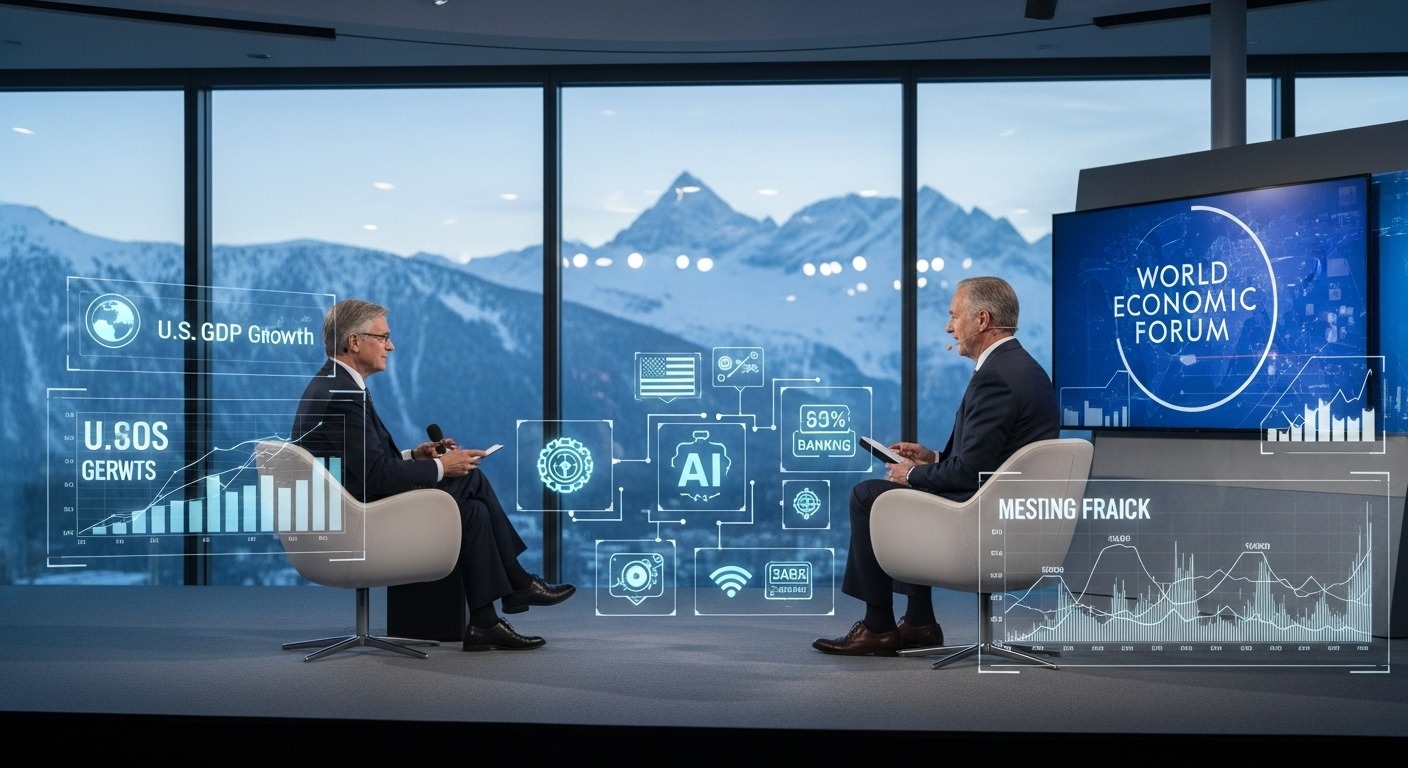
At the World Economic Forum in Davos, Switzerland, optimism about the U.S. economy took center stage as Bank of America Chairman and CEO Brian Moynihan shared an upbeat outlook during an interview with Maria Bartiromo. From stronger GDP expectations and resilient consumer spending to artificial intelligence investments and debates over credit card interest rate caps, Moynihan’s comments painted a picture of an economy that remains fundamentally solid—even as policy risks and technological disruptions loom.
Raising GDP Expectations: Confidence Beyond Consensus
Bank of America recently raised its U.S. GDP growth forecast from 2.6% to 2.8%, a figure that stands well above Wall Street consensus. According to Moynihan, this shift reflects more than just economic modeling—it reflects real-world behavior from Bank of America’s massive client base.
Consumer spending data from the first weeks of January showed improvement compared to December, which itself followed a strong Thanksgiving and holiday season. Credit availability remains healthy, delinquency trends are stable, and lending capacity is intact. These indicators suggest that the U.S. economy has enough underlying momentum to continue growing at a solid pace.
Importantly, Moynihan emphasized that this optimism is grounded in what clients are actually doing, not just theoretical assumptions. Businesses are spending, consumers are holding up, and the financial system is functioning smoothly—key ingredients for sustained growth.
Tax Policy and Small Businesses: A Quiet Tailwind
One of the less discussed but highly impactful themes Moynihan highlighted was the effect of recent tax legislation. Provisions related to depreciation, tax certainty, and incentives for investment are proving particularly beneficial for small and mid-sized businesses.
Small business clients, Bank of America’s largest constituency, are adjusting to tariffs and cost pressures while continuing to hire and invest. The ability to depreciate investments more favorably has encouraged capital spending, which feeds directly into productivity and job creation. According to Moynihan, this is a major reason Bank of America’s research team has grown more optimistic about economic growth in 2025 and beyond.
While artificial intelligence dominates headlines, Moynihan reminded audiences that “the rest of America” is also benefiting from tax stability and pro-growth policies—an often overlooked factor in the current economic narrative.
Artificial Intelligence: Evolution, Not Elimination
AI has become a flashpoint in economic discussions, particularly around fears of job displacement. Moynihan pushed back strongly against the idea that AI is a near-term job killer.
Bank of America employs more than 213,000 people and continues to hire thousands annually, including permanent roles and early-career positions. While overall headcount has remained relatively flat due to natural turnover, the bank has consistently redeployed workers into revenue-generating and client-facing roles as technology improves efficiency elsewhere.
AI, Moynihan argued, is an extension of a long-running trend. The bank has been applying automation and advanced analytics for years, gradually lowering costs while improving service. Rather than replacing workers wholesale, AI allows employees to focus on higher-value tasks—driving productivity rather than unemployment.
A $14 Billion Technology Commitment
Bank of America’s technology spending underscores its long-term commitment to innovation. The bank invests approximately $14 billion annually in technology, with around $5 billion dedicated to new code development. A growing share of this budget is now directed toward AI-related initiatives.
The bank’s digital assistant, Erica, launched in 2018, is a prime example of AI in action. Over time, Erica evolved from a reactive tool into a proactive system that delivers alerts, insights, and customer support automatically. These improvements have strengthened customer engagement while reducing friction in everyday banking.
Beyond customer-facing tools, Bank of America is deploying AI internally through platforms like Microsoft 365 Copilot, enhancing productivity for over 150,000 employees. With dozens of AI projects underway, Moynihan made it clear that the bank views AI as a strategic necessity—not a speculative bet.
Employee Ownership and Long-Term Stability
Another standout theme from the interview was Bank of America’s commitment to its workforce. Since the passage of tax reform during President Trump’s first term, the bank has distributed billions of dollars in stock grants to employees through its Success Sharing program.
Now in its ninth consecutive year, the program distributes roughly $1 billion in stock annually, with about 96% going to non-executive employees. Over time, more than $7 billion has been shared, reinforcing a culture of ownership and alignment between employees and shareholders.
Moynihan stressed that tax certainty is critical to sustaining such programs. For capital-intensive businesses like banking—where investments in branches, data centers, and technology span many years—stable tax policy enables long-term planning and consistent employee investment.
Credit Card Rate Caps: Balancing Affordability and Access
The discussion turned more political when Bartiromo asked about proposals to cap credit card interest rates at 10%. Moynihan acknowledged that affordability is a genuine concern in America but warned against simplistic solutions.
Bank of America has already taken steps to support consumers, including offering emergency loans with no interest, reducing overdraft fees, and eliminating overdrafts for many accounts. These initiatives aim to ease financial stress without restricting access to credit.
A strict rate cap, however, could reduce credit availability—especially for higher-risk borrowers—and ultimately increase borrowing costs elsewhere. Moynihan suggested that collaboration between policymakers and financial institutions is essential to address affordability without unintended consequences.
Federal Reserve, Inflation, and Rate Cuts
On monetary policy, Moynihan struck a balanced tone. Bank of America expects two rate cuts next year, driven more by labor market softening than by inflation. While inflation remains above the Fed’s 2% target, it appears to be stabilizing.
Maintaining employment, Moynihan argued, is crucial. An unemployment rate in the 4–4.5% range is healthy, and steady job formation helps anchor inflation expectations. As long as consumers believe prices will stabilize, demand is unlikely to collapse.
Looking Ahead: Deals, IPOs, and Market Activity
Finally, Moynihan expressed optimism about capital markets activity. Deal pipelines are full, IPOs are slowly reopening, and private equity firms are eager to bring long-held assets to market. With regulatory conditions improving and confidence returning, 2026 could see a resurgence in mergers, acquisitions, and public offerings.
Conclusion
Brian Moynihan’s message from Davos was clear: despite political noise, technological disruption, and macro uncertainty, the U.S. economy remains resilient. Strong consumer behavior, disciplined AI investment, supportive tax policy, and a focus on affordability without sacrificing access form the backbone of Bank of America’s optimistic outlook.