Introduction
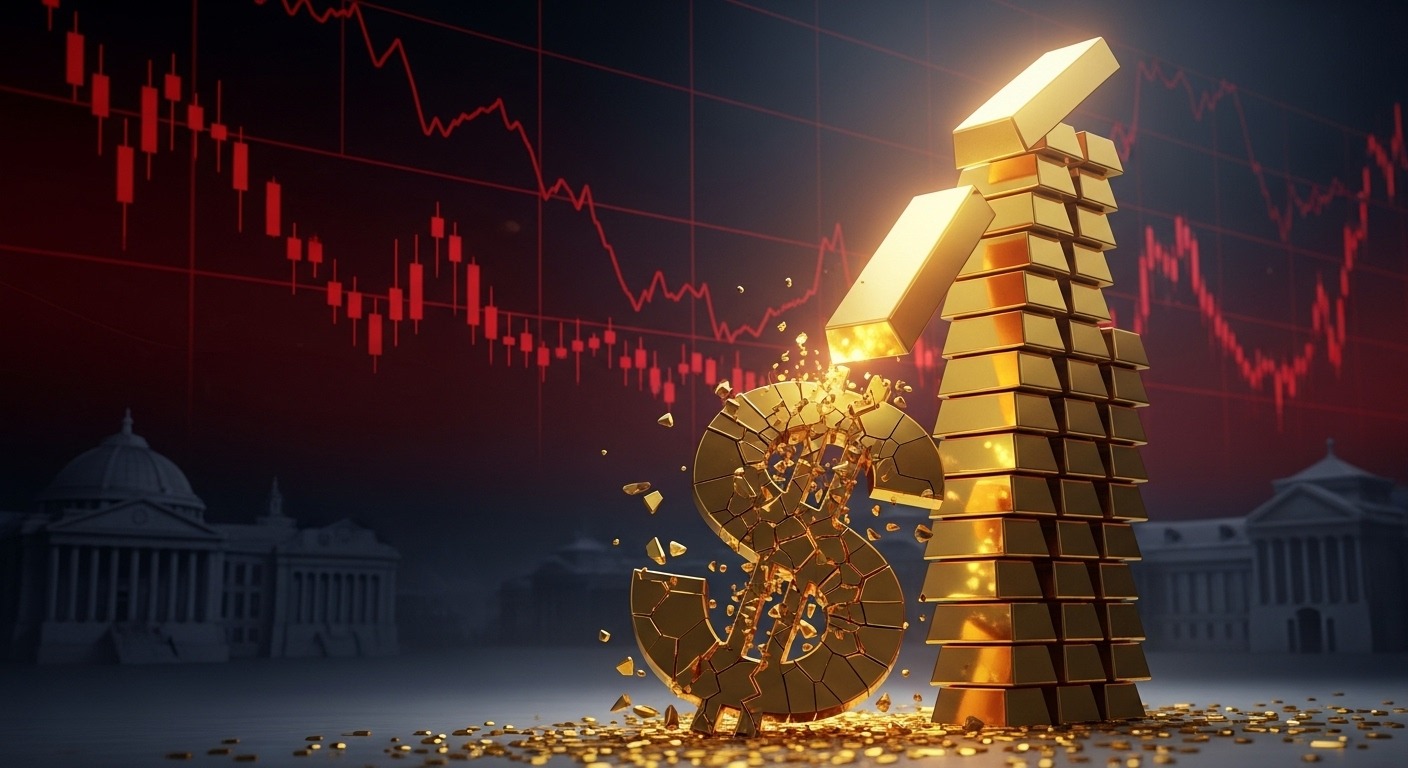
Gold has once again rewritten financial history. According to Fox Business, gold reached its highest closing price ever, surging to nearly $5,800 per troy ounce, just a day after breaking above $5,100. What may look like a simple rally in precious metals is, according to many analysts, a much deeper warning about the state of the U.S. economy and the global financial system.
Investors have been piling into gold for more than a year, but the rally has accelerated amid tariff uncertainty, rising government debt, a weakening U.S. dollar, and growing fears of an economic slowdown. Veteran economist and market strategist Peter Schiff believes this move is not speculative hype—but a signal of a coming dollar crisis.
Why Gold Is Soaring to Historic Levels
Gold traditionally performs best when confidence in fiat currencies and governments declines. Today’s environment checks every box:
-
Escalating trade tensions
-
Threats of new tariffs on Canadian and South Korean imports
-
A looming U.S. government shutdown
-
Rising geopolitical uncertainty
-
A critical Federal Reserve interest rate decision
Each of these factors has pushed investors toward safe-haven assets, with gold emerging as the clear winner.
As uncertainty rises, investors seek assets that cannot be printed, inflated, or politically manipulated—and gold fits that role perfectly.
The Weakening Dollar: A Major Catalyst
One of the strongest drivers behind gold’s rally is the decline of the U.S. dollar. The dollar index has fallen to a four-year low against the Swiss franc, while weakening broadly against most major currencies.
At the same time:
-
Consumer confidence has plunged to a 12-year low
-
Purchasing power continues to erode due to inflation
-
Real wages remain under pressure despite headline economic data
Peter Schiff argues that official economic numbers are misleading, distorted by inflation and temporary factors. According to him, gold and silver are sending a clearer message than government statistics.
“Gold and silver are doing exactly what they did before the 2008 crisis—warning investors that something much bigger is coming.”
Tariffs, Spending, and the Debt Problem
The U.S. national debt has now crossed $38.6 trillion, and deficits continue to expand with no meaningful spending cuts in sight. While tariffs are often framed as a tax on foreign countries, Schiff argues the reality is different.
Tariffs:
-
Are ultimately paid by American consumers
-
Increase prices on imported goods
-
Reduce global trade efficiency
-
Hurt confidence in the U.S. economy
Rather than strengthening the economy, aggressive tariff policies may be accelerating dollar weakness, pushing investors further toward gold.
Why Central Banks Are Buying Gold Aggressively
Another critical but often overlooked factor is the behavior of global central banks. Around the world, central banks are:
-
Reducing their exposure to U.S. dollars
-
Selling U.S. Treasuries
-
Increasing gold reserves at a rapid pace
This trend reflects a growing lack of confidence in the long-term stability of the dollar-based financial system. Gold is increasingly viewed as a neutral reserve asset, free from political risk.
Schiff summarizes it bluntly:
“There is no floor under the dollar, which means there is no ceiling on gold.”
A Crisis Bigger Than 2008?
According to Schiff, the world is not heading toward another global financial crisis—but rather an American financial crisis. Unlike 2008, which spread internationally, he believes the next downturn will hit the U.S. hardest.
Key differences this time:
-
The U.S. is more indebted than ever
-
Interest rates are already elevated
-
Confidence in the dollar is weakening globally
-
Central banks are better prepared outside the U.S.
Schiff warns that this crisis could make 2008 “look like a Sunday school picnic,” particularly if the dollar loses its reserve currency dominance.
Gold Mining Stocks: Still Undervalued?
Despite massive gains in gold prices, many gold and silver mining stocks remain undervalued relative to their earnings growth.
Schiff previously recommended:
-
Agnico Eagle Mines (up over 160%)
-
Pan American Silver (up over 200%)
Yet he argues these stocks are actually cheaper today because profits have grown faster than share prices.
He believes the next phase of the rally will be led by:
-
Junior mining stocks
-
Smaller companies largely ignored by mainstream investors
For most investors, he suggests exposure through professionally managed funds rather than trying to pick individual juniors.
Is Gold in a Bubble? Or Is the Dollar the Bubble?
Critics often label gold’s rise as a bubble. Schiff strongly disagrees.
In his view:
-
Gold is real money
-
The U.S. dollar is the bubble
-
Stock market record highs are an illusion created by inflation
When U.S. stocks are measured in gold rather than dollars, many are far below their historical highs, reinforcing the argument that real wealth has been declining.
Conclusion
Gold’s historic surge is more than just a market headline—it is a signal of declining trust in the U.S. dollar, government finances, and economic management. Rising debt, persistent deficits, trade tensions, and global de-dollarization are creating the perfect storm for precious metals.
Whether one agrees with Peter Schiff’s most extreme predictions or not, one reality is hard to ignore: gold is behaving exactly as it does when confidence in the system begins to crack.
For investors, policymakers, and everyday consumers alike, gold’s message is clear—uncertainty is rising, and the financial landscape is changing.