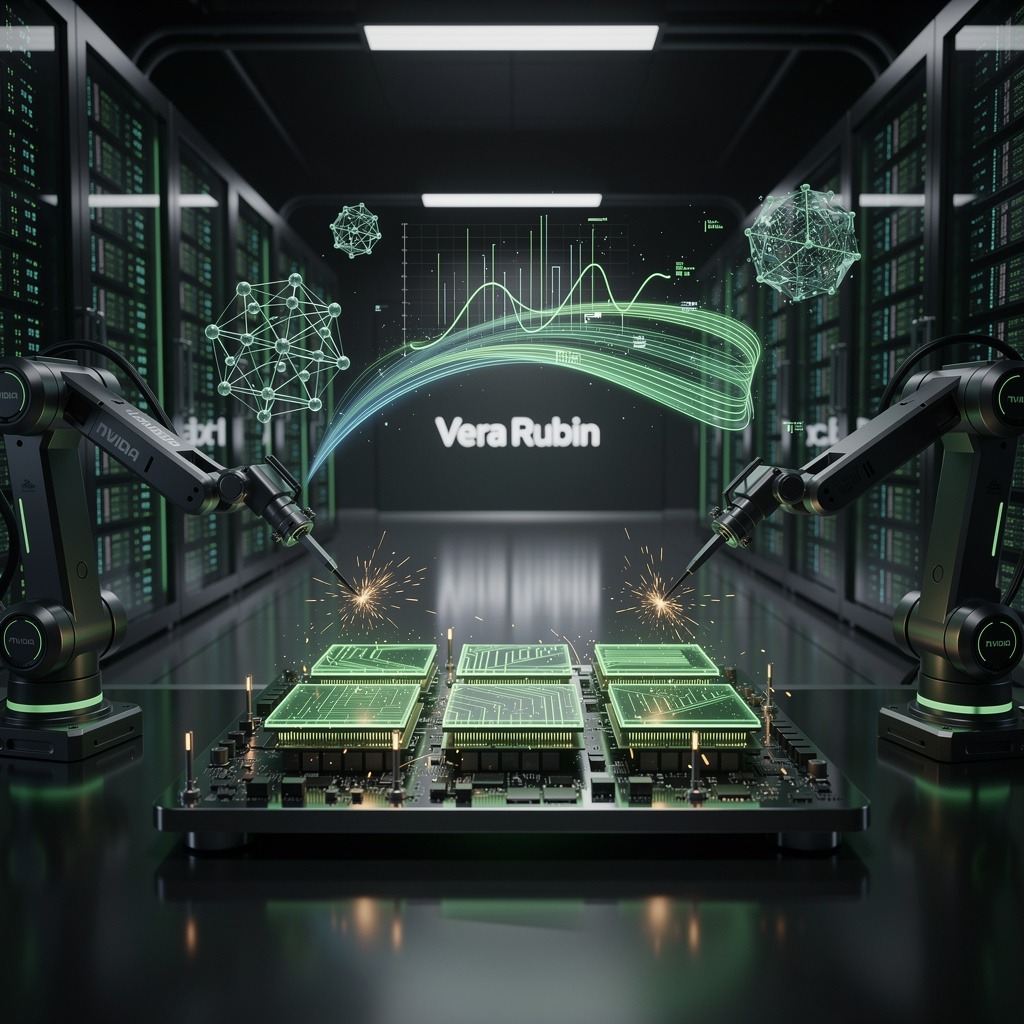
Nvidia is once again positioning itself at the center of the global artificial intelligence revolution. With the announcement that its next-generation computing platform, Vera Rubin, is now in full production, the world’s most valuable chipmaker is signaling that it has no intention of surrendering its dominance in AI hardware. As artificial intelligence expands beyond chatbots into robotics, autonomous vehicles, and intelligent agents, Nvidia believes Vera Rubin represents a foundational leap forward.
Nvidia CEO Jensen Huang has described the platform as “completely revolutionary,” suggesting it could even become an industry standard in the future. That is no small claim from a company already valued at more than $4.5 trillion, whose chips power much of today’s AI infrastructure.
What Is Vera Rubin?
Vera Rubin is Nvidia’s next-generation supercomputing architecture, designed to deliver massive performance gains while consuming less power than previous platforms. According to Nvidia, the system uses six tightly integrated chips, operating as a unified platform rather than isolated components. This “system-level” design is central to Nvidia’s strategy and a major reason the company has stayed ahead of competitors.
Unlike earlier generations focused mainly on training large language models, Vera Rubin is built for a broader AI future. Nvidia sees AI moving beyond text-based tools like ChatGPT and into real-world applications—machines that can reason, act, and make decisions autonomously.
AI Is Evolving Beyond Chatbots
At events like CES, the message from technology leaders is increasingly clear: AI’s next phase is about agents, robotics, and physical-world intelligence. These systems require far more computing power and efficiency than today’s models.
AI agents capable of completing tasks, coordinating workflows, or operating machinery need real-time decision-making. Robotics and self-driving vehicles demand low latency, extreme reliability, and energy efficiency. Vera Rubin is designed specifically to support these demands.
Emily Barry, assistant managing editor at MarketWatch, explains that this shift is driving the need for new chip architectures. More powerful processors are essential—but so is reducing energy consumption, as power availability is becoming a growing constraint on AI expansion.
The Power Problem—and Nvidia’s Answer
One of the biggest challenges facing AI today is energy consumption. Data centers already draw enormous amounts of electricity, and governments and utilities are struggling to keep up with projected demand. Investors and policymakers alike are increasingly concerned that power shortages could slow AI growth.
Nvidia claims Vera Rubin significantly improves performance per watt, allowing companies to do more computing with less energy. This efficiency advantage is critical, especially as hyperscalers race to build massive AI data centers around the world.
By addressing power constraints head-on, Nvidia strengthens its position not just technologically, but politically and economically as well.
Self-Driving Cars: A Strategic Expansion
Although Nvidia is best known for GPUs and AI accelerators, the company is also making aggressive moves into autonomous driving. At CES, Nvidia unveiled new technologies aimed at powering self-driving systems, an area often associated more with Tesla than chipmakers.
Nvidia believes autonomous vehicles will become a core AI market over the next decade. In a future where consumers rely on shared, self-driving fleets instead of owning cars, the demand for high-performance AI computing will skyrocket.
To that end, Nvidia has announced a new partnership with Mercedes-Benz, reinforcing its ambition to become a foundational supplier for autonomous driving platforms. While Tesla CEO Elon Musk has downplayed the near-term competitive threat, he has acknowledged Nvidia could become a rival several years down the line.
Bubble Fears and Market Pressure
Despite Nvidia’s optimism, questions remain about whether the AI boom is sustainable. Critics warn of a potential AI investment bubble, with companies pouring billions into infrastructure before returns are fully proven.
Nvidia, however, appears confident. By continuously releasing more advanced platforms, the company is betting that AI adoption will deepen across industries—from healthcare and manufacturing to transportation and defense.
Rather than focusing on a single application, Nvidia’s strategy is to build general-purpose AI infrastructure, ensuring that whatever form the next AI breakthrough takes, it runs on Nvidia hardware.
A System-Level Advantage
One of Nvidia’s greatest strengths is its ability to integrate hardware, software, and networking into a unified ecosystem. Vera Rubin is not just a chip—it’s a complete platform optimized for AI workloads.
This approach makes it difficult for rivals to compete on price or performance alone. Customers buying into Nvidia’s ecosystem benefit from optimized tools, libraries, and developer support that competitors struggle to match.
If Vera Rubin lives up to its promise, it could extend Nvidia’s lead for years, reinforcing its role as the backbone of the global AI economy.
Looking Ahead
With Vera Rubin scheduled for launch later this year, expectations are sky-high. The platform arrives at a critical moment, as AI moves from experimentation to real-world deployment at massive scale.
Whether powering intelligent agents, autonomous vehicles, or next-generation robotics, Nvidia’s new architecture aims to define what AI can do next. While concerns about bubbles and energy constraints remain, Nvidia is betting that efficiency, performance, and system-level innovation will keep it ahead of the pack.
If history is any guide, that bet may well pay off.